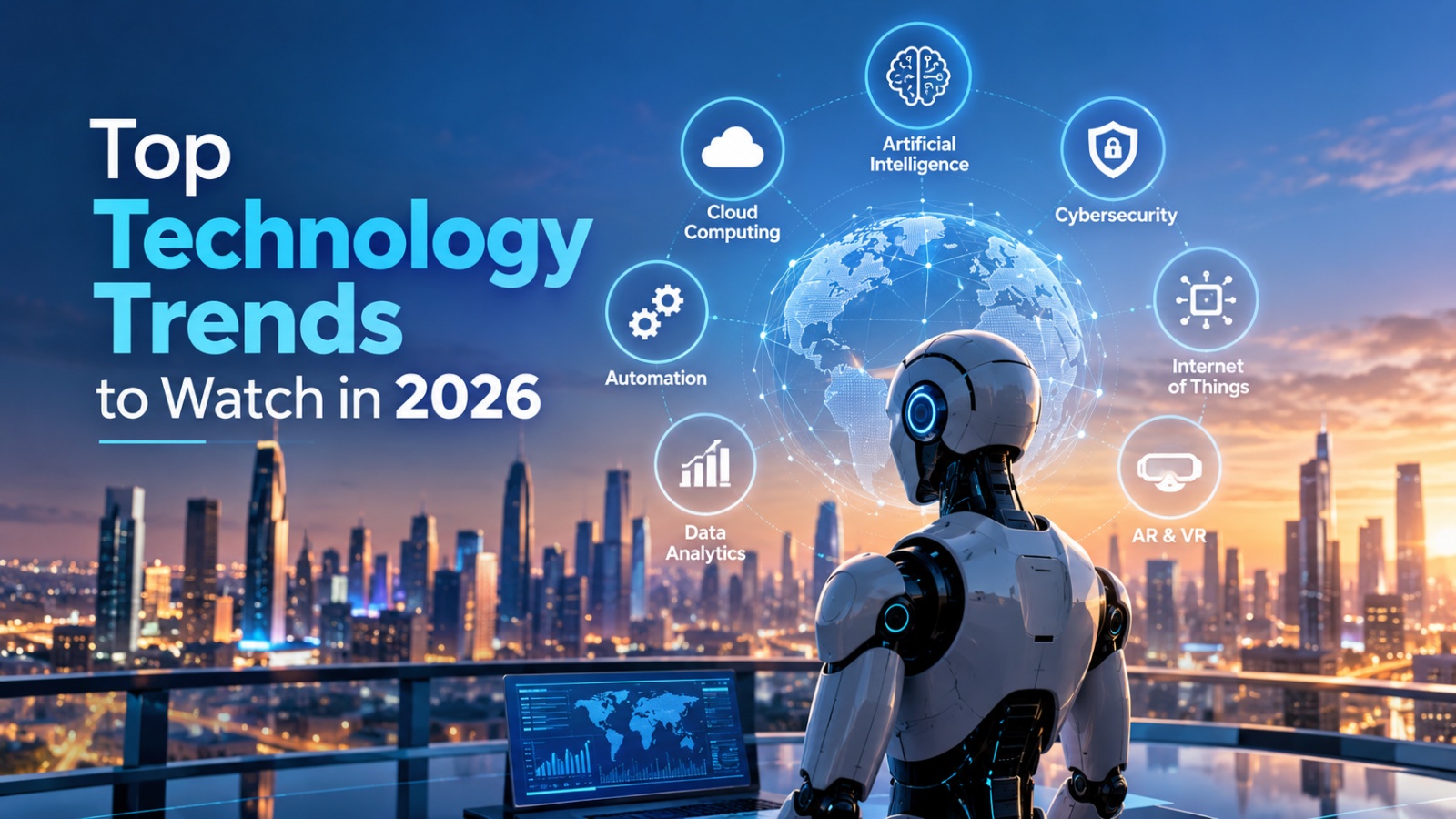
Top Technology Trends to Watch in 2026
Category: Technology
Tags: Technology Trends, Artificial Intelligence, Cloud Computing, Cybersecurity, Automation, Internet of Things, Digital Transformation
Introduction
Technology continues to evolve rapidly, transforming how businesses operate, how people communicate, and how we interact with the digital world. In 2026, emerging technologies such as artificial intelligence, automation, cloud computing, and cybersecurity are helping organizations improve efficiency, enhance customer experiences, and remain competitive.
Understanding these technology trends can help businesses and individuals prepare for future opportunities and make smarter decisions.
1. Artificial Intelligence and Generative AI
Artificial intelligence (AI) remains one of the most influential technology trends. Businesses are using AI-powered tools to automate repetitive tasks, analyze data, generate content, and provide personalized customer experiences.
Generative AI is also helping organizations improve software development, customer support, and business operations. As these tools evolve, companies will increasingly focus on responsible AI adoption, accuracy, and data privacy.
2. Automation and Intelligent Workflows
Automation is helping businesses reduce manual work and improve productivity. From automated customer service to document processing and workflow management, organizations can complete routine tasks faster and more consistently.
Combining AI with automation allows businesses to streamline operations, reduce errors, and give employees more time to focus on strategic activities.
3. Cloud Computing and Edge Computing
Cloud computing continues to provide businesses with flexible infrastructure, scalable storage, and access to applications from different locations.
Edge computing complements cloud technology by processing data closer to where it is generated. This can reduce delays and improve performance for applications such as connected devices, industrial systems, and real-time monitoring.
Together, these technologies help organizations build more responsive and scalable digital services.
4. Cybersecurity and Data Privacy
As businesses become more digitally connected, protecting sensitive information is increasingly important. Cybersecurity threats, phishing attacks, ransomware, and identity theft remain significant concerns.
Organizations are strengthening their security strategies through multifactor authentication, encryption, regular software updates, employee training, and zero-trust security approaches.
Investing in cybersecurity helps protect customer information, maintain trust, and reduce the risk of costly disruptions.
5. Internet of Things (IoT)
The Internet of Things connects physical devices to the internet, enabling them to collect and exchange data. Smart homes, connected vehicles, wearable devices, and industrial sensors are examples of IoT applications.
In 2026, IoT continues to support smarter monitoring, predictive maintenance, energy management, and operational efficiency across multiple industries.
6. Low-Code and No-Code Development
Low-code and no-code platforms make it easier to build applications with minimal traditional programming. These tools help businesses develop internal systems, automate workflows, and create digital solutions more quickly.
Although complex applications may still require professional developers, these platforms can reduce development time and help teams turn ideas into working solutions.
7. Augmented Reality and Virtual Reality
Augmented reality (AR) and virtual reality (VR) are creating new ways for people to learn, collaborate, shop, and experience digital environments.
Businesses can use these technologies for employee training, product demonstrations, virtual tours, and interactive customer experiences. As hardware and software improve, AR and VR may become more accessible across additional industries.
8. Sustainable and Energy-Efficient Technology
Sustainability is becoming an important consideration in technology decisions. Organizations are exploring energy-efficient data centers, optimized cloud workloads, renewable energy, and longer-lasting electronic equipment.
Improving energy efficiency can help businesses manage operating costs while reducing the environmental impact of digital infrastructure.
9. Advanced Data Analytics
Data analytics helps businesses understand customer behavior, measure performance, identify patterns, and make informed decisions.
With AI-assisted analytics and improved data platforms, organizations can turn large amounts of information into useful insights. However, reliable results depend on data quality, appropriate governance, and responsible use of information.
10. AI-Powered Customer Experiences
Customers increasingly expect fast, convenient, and personalized digital services. AI-powered chatbots, virtual assistants, recommendation systems, and automated support tools can help businesses respond to customer needs more efficiently.
The best results come from combining automation with human assistance when situations require judgment, empathy, or specialized knowledge.
Conclusion
Technology trends in 2026 are creating new opportunities for innovation, business growth, and improved productivity. Artificial intelligence, automation, cloud computing, cybersecurity, IoT, and data analytics are helping organizations adapt to a rapidly changing digital environment.
Businesses do not need to adopt every new technology at once. Instead, they should identify their goals, evaluate practical benefits, protect their data, and invest in solutions that address real challenges.
Staying informed about emerging technology trends can help organizations make better decisions and build a stronger foundation for the future.